Named roles and visible handoffs.
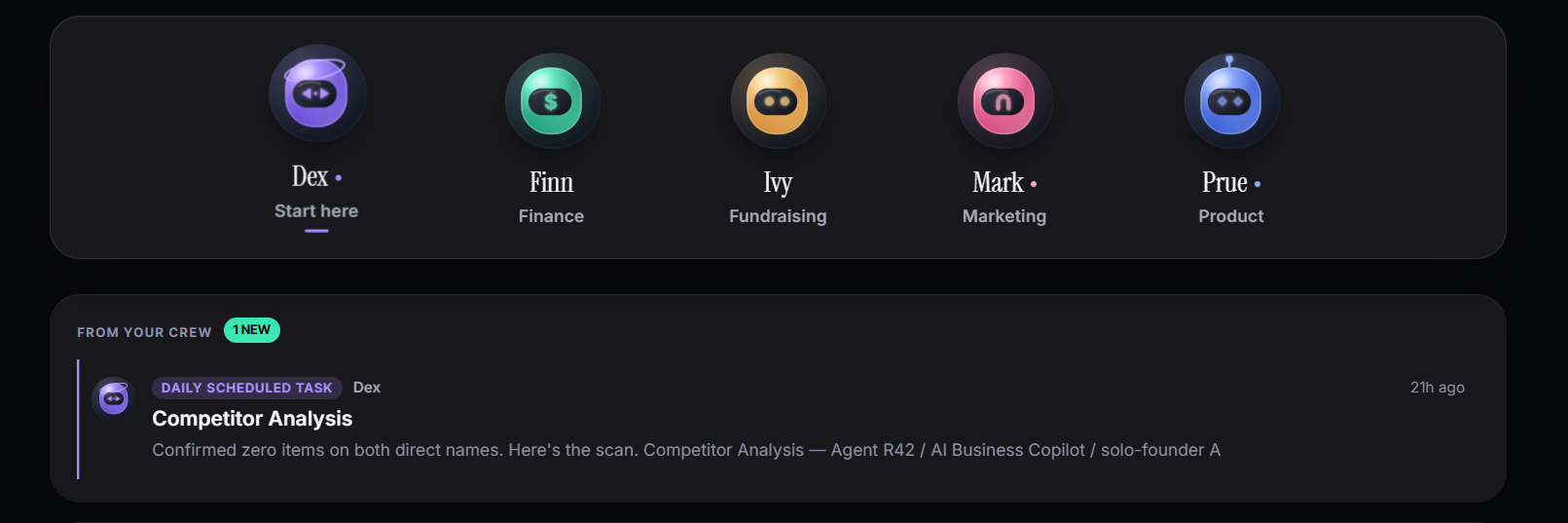
Dex, Finn, Ivy, Mark, and Prue have distinct identities. The conversation identifies when a task moves from the router to a specialist.


A founder covers every function. Ventora brings specialist AI agents into one workspace, with shared context and human approval before anything goes out.
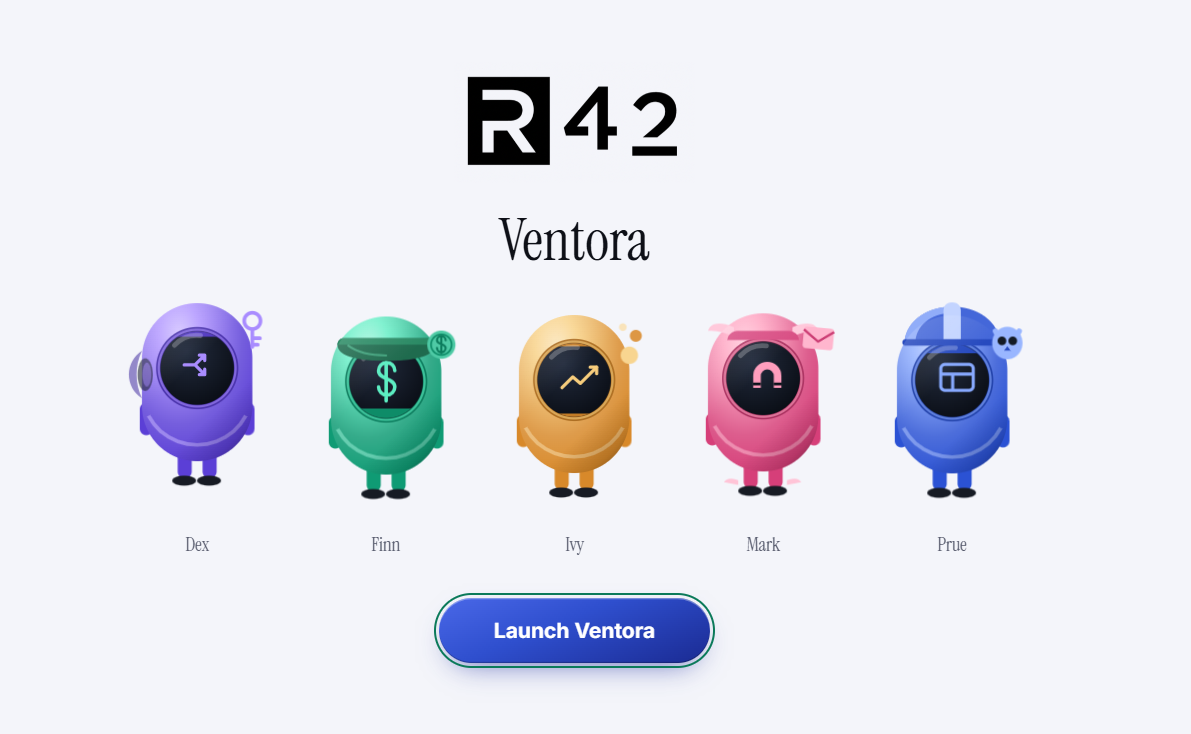
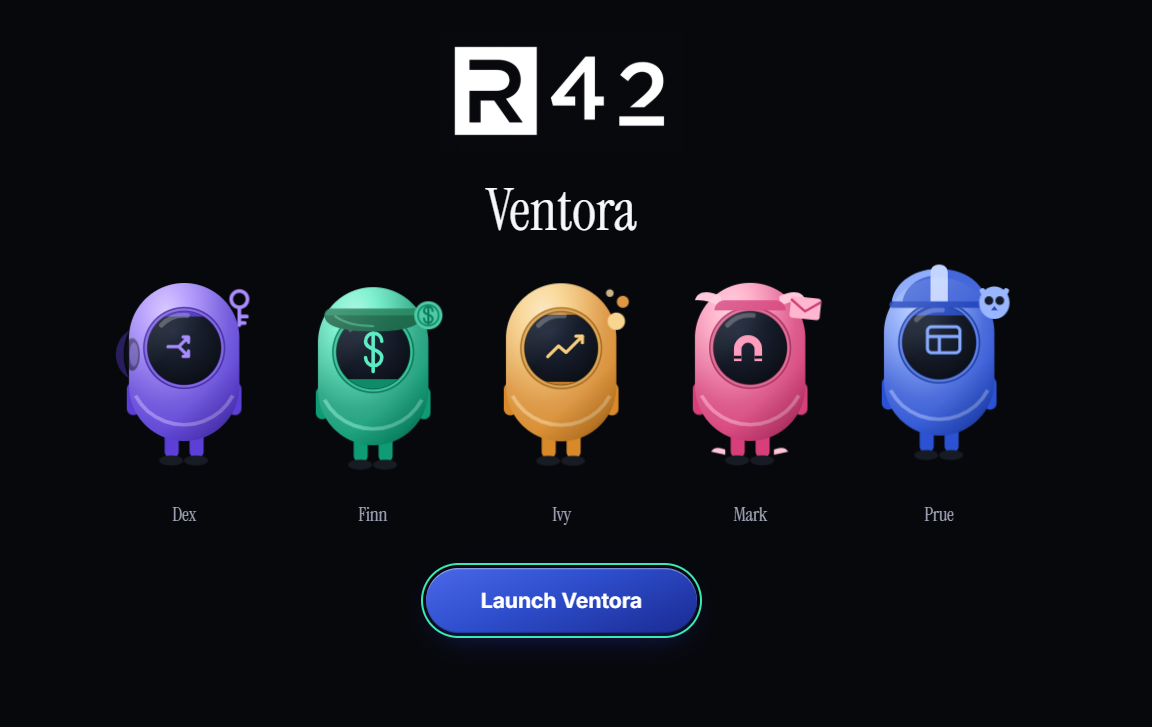
Switching between finance, marketing, fundraising, and product means switching tools and losing context. The team’s response was a small crew of agents with defined roles, one shared memory, and decisions gated by the founder.
I led product design and frontend: the founder-facing experience, agent screens, responsive layouts, and light/dark interface treatments.
A five-person fellowship team connected the interface to an agent framework and real tools. My design work sat alongside research, agent personas, and system integration.
Start with Dex when you don’t know whose desk a task belongs on, or go directly to a specialist. Each role has its own persona and access scope.
The starting point when a founder does not know which specialist to ask. Dex routes the request to the relevant role.
Mark’s marketing desk offers prompts for leads and outreach. The suggestions are specific to the business, giving the founder an immediate way into the conversation.
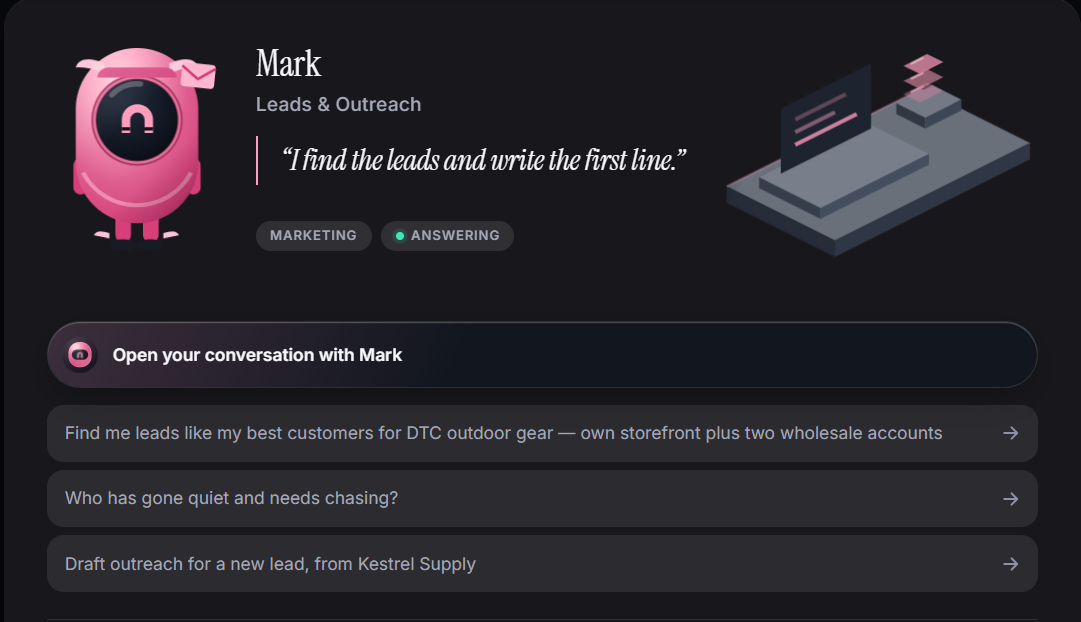
The marketing flow in the final demo.
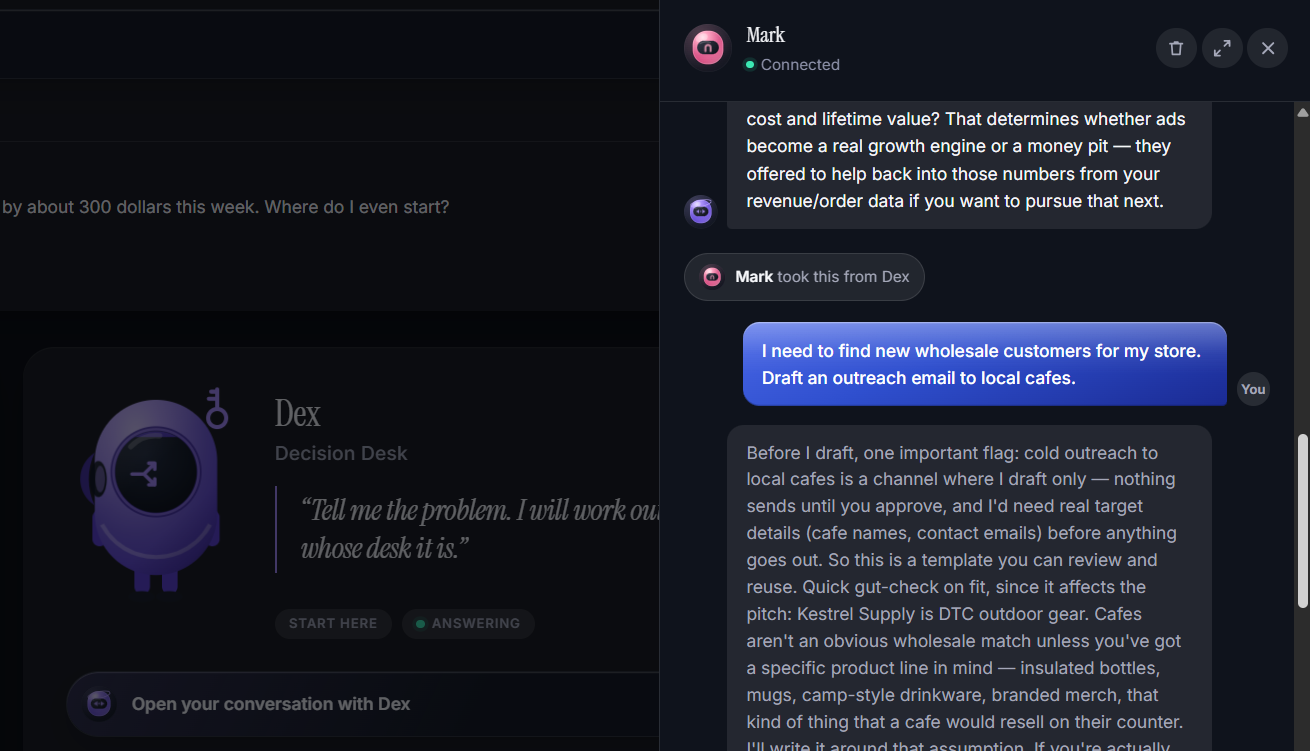
“I need to find new wholesale customers for my store. Draft an outreach email to local cafes.”
The interface identifies the specialist: “Mark took this from Dex.”
Mark explains the limits: nothing sends until the founder approves, and real contact details are needed.
Original Demo Day recording · 8 min
The interface needed to explain who was working, carry the business context, and keep the founder’s authority clear.
Dex, Finn, Ivy, Mark, and Prue have distinct identities. The conversation identifies when a task moves from the router to a specialist.
Business-specific suggestions and a “From your crew” feed bring the agent team’s work back into the founder’s workspace.
Client-facing output and irreversible actions require human review. The approval boundary is part of the product model, not an assumption left to the user.
The team built three connected layers: the frontend the founder uses, the agents that route and draft, and the infrastructure that connects them to tools.
The founder’s request goes to /api/agent.
Authentication and routing to the backend path.
The gateway loads the relevant agent profile.
Scoped connections to Gmail, Sheets, Drive, and GitHub.
Keeping context, reaching real tools, and making the Vercel interface agree with the Hermes gateway were documented team challenges. The backend ran on Hostinger with Docker; agent permissions were scoped by role.
R42 Institute · Led by Dr. Ronjon Nag · Mentor: Zixuan An
We worked directly with Praveena, founder of Soopra AI, to understand her operating challenges. Her input reframed proactive prompting, extended the specifications, and helped settle the human-approval policy.
“He has demonstrated great business and product sense to design and build the project in the team from scratch.”